
Database Fundamentals
Relational Databases, NoSQL, and Forensic Artifacts
A deeper guide to relational data models, normalization, joins, transactions, SQLite sidecar files, and document, key-value, wide-column, and graph databases.
Revision: Initial publication and technical review.
Relational databases organize facts and relationships
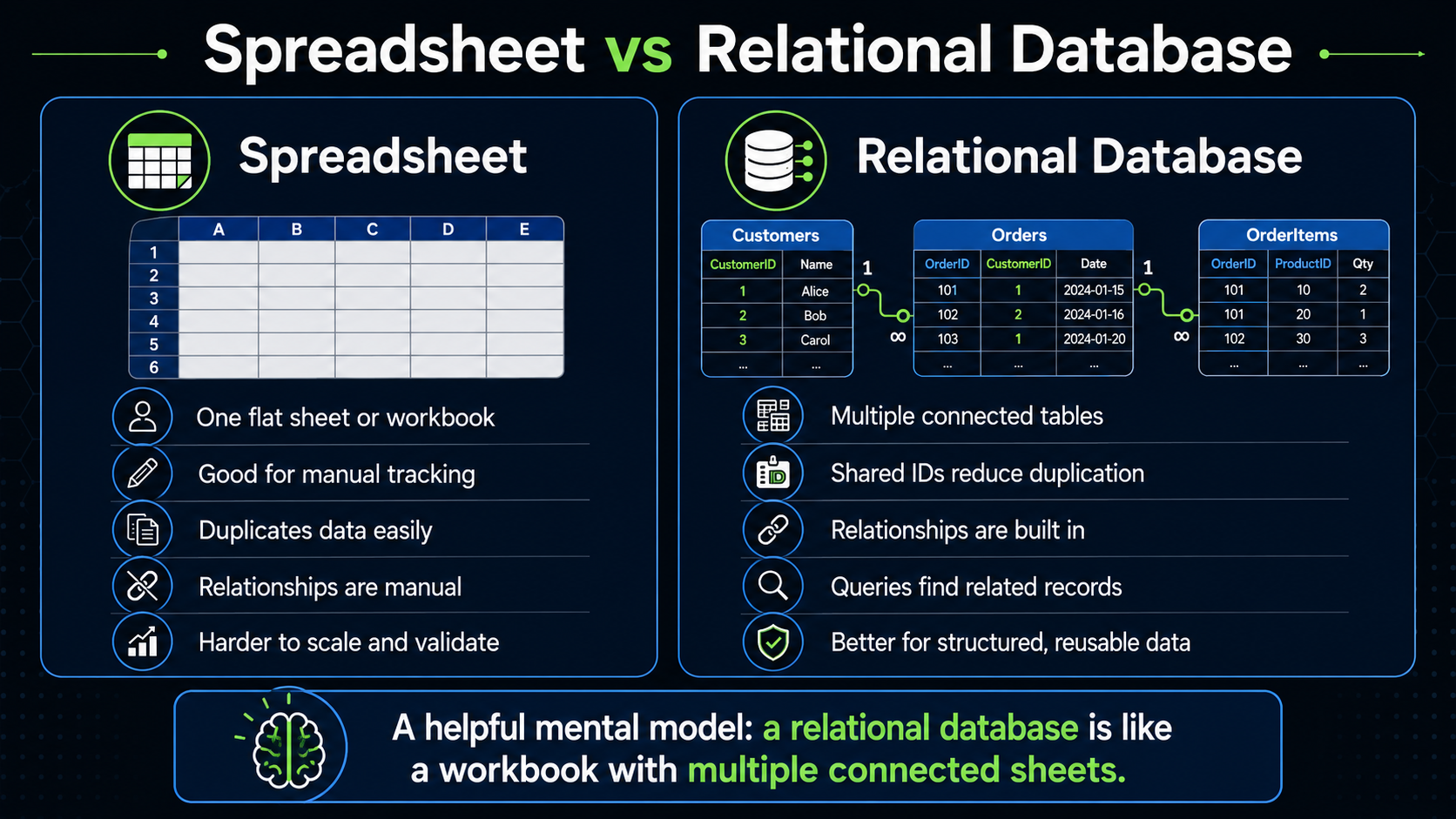
A relational design separates different kinds of records into tables and connects them using keys.
Cases -> Evidence -> Acquisitions -> Hashes
One case can have many evidence items, one evidence item can have multiple acquisitions, and one acquisition can have multiple hash records.
Not every database organizes information the same way. Relational databases are built around connected tables, document databases store flexible records, key-value databases retrieve values by key, and graph databases focus on relationships between entities.
For most forensic artifacts, SQLite matters because it is a relational database, but understanding the other models helps explain why not every app stores data in the same structure.
Relationship types
One-to-one
One record connects to one record.
One-to-many
One case has many evidence items.
Many-to-many
Many tags can apply to many notes. A linking table, such as note_tags, connects them.
Normalization
Normalization reduces unnecessary duplication. Instead of writing the examiner’s full name in every acquisition row, store the examiner once and reference an ID.
Benefits include fewer inconsistent spellings, easier updates, smaller records, and clearer relationships.
Over-normalization can make simple reads harder, so design is a tradeoff.
Joins
A join combines related rows.
SELECT cases.case_number, evidence.description
FROM cases
JOIN evidence ON evidence.case_id = cases.case_id;
Constraints
Relational databases can enforce rules:
- Unique primary keys
- Required fields
- Valid foreign keys
- Expected values
- Prohibited duplicate combinations
Transactions
A transaction groups changes into one unit. It either completes or rolls back.
The familiar ACID concepts are atomicity, consistency, isolation, and durability. Exact guarantees vary by product and configuration.
SQLite architecture
SQLite is embedded in the application rather than accessed through a separate server.
The main database may be accompanied by:
-walwrite-ahead log-shmshared-memory file- Rollback journal
These sidecar files may contain recent or uncheckpointed changes. Copying only the main file while an application is active can produce an incomplete view.
SQLite pages and records
SQLite stores data in pages that may contain table B-trees, indexes, schema information, overflow data, free space, or freelist content.
Forensic tools may handle allocated records, freelist material, WAL frames, and journals differently. Validation matters.
SQL does not automatically mean purely relational
Modern relational systems may support JSON, arrays, full-text search, graph features, and vectors. NoSQL systems may support transactions, schemas, joins, and SQL-like languages.
The labels describe primary data models, not absolute capability boundaries.
Document databases
MongoDB stores BSON documents in collections. Documents contain fields, nested documents, and arrays.
Advantages can include flexible record shapes and natural mapping to application objects.
Forensic considerations include dynamic schemas, nested records, object identifiers, replication, cloud architecture, and storage-engine behavior.
Key-value databases
A key identifies a value.
session:1058 -> user data
Redis supports keys mapped to strings and richer structures such as hashes, lists, sets, sorted sets, streams, and JSON.
Forensic considerations include in-memory data, persistence files, expiration, eviction, replication, binary values, and application-defined key names.
Wide-column databases
Systems such as Cassandra and HBase organize data around partition keys and column families for large distributed workloads.
Graph databases
Systems such as Neo4j emphasize nodes, relationships, and properties. They are useful when traversing connections is the primary task.
Choosing a model
Use relational databases when relationships, consistency, transactions, and structured querying are central.
Consider documents when records are naturally nested and flexible.
Consider key-value when fast lookup by a known key dominates.
Consider graph when relationship traversal is the central operation.
Real systems often combine models.
Why SQLite can fit ByteCase
SQLite is a reasonable future local-data option because it is embedded, portable, transactional, queryable, and suitable for connected records.
That does not mean every ByteCase output should disappear into one database. A future database can coordinate structured data while readable reports and exportable files remain available outside the application.
Examiner takeaway
Identify:
- Database product and version
- Storage model
- Main and sidecar files
- Application schema
- Timestamps and encodings
- Deleted-data behavior
- Encryption or compression
- Parsing-tool limitations
Source notes
- SQLite Documentation — Primary reference for SQLite architecture, files, SQL behavior, and storage.
- PostgreSQL Tutorial — Primary reference for relational tables, queries, joins, and transactions.
- MongoDB Manual — Primary reference for document-oriented storage.
- Redis Data Types — Primary reference for key-value and data-structure concepts.