ByteCase tool suite

Five tools prepared for the first signed release cycle.

Intake, Acquire, Verify, Notes, and Validate have reached their current pre-release milestones. The case-centered tools already write into one shared ByteCase case folder, giving examiners a connected workflow today without waiting for Hub or orchestration.

Second-monitor workflow

Built for the second monitor.

Capture the record while the work is still in context.

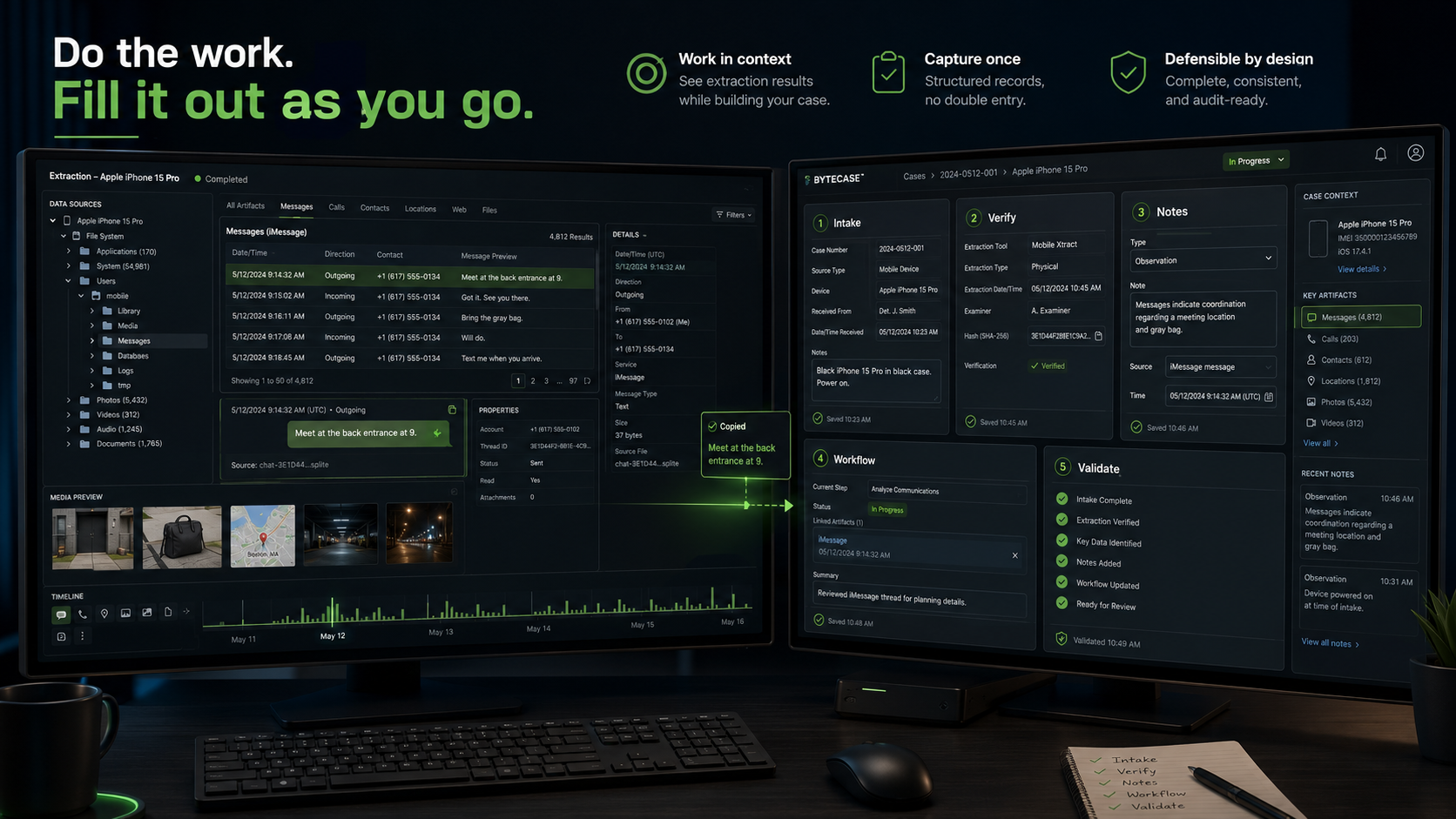
ByteCase is designed to sit beside the forensic tools examiners already use. Keep the extraction, analysis, or review platform open on the primary monitor, then use ByteCase on the second monitor to document the work as it happens.

Dual-monitor digital forensics workstation with an extraction and analysis platform on the left monitor and ByteCase workflow documentation tools on the right monitor.
Review the extraction or analysis on one screen while capturing structured intake, verification, notes, workflow, and validation records on the other. The illustrated interfaces represent the intended workflow direction rather than a released unified ByteCase application.
01

Work in context

Keep the source information visible while recording the applicable details. Copy identifiers, timestamps, tool information, and observations directly from the examination instead of reconstructing them later.

02

Capture once

Enter the record when the work occurs. ByteCase modules are intended to preserve reusable local records instead of forcing the examiner to repeat the same information across temporary notes and final reports.

03

Preserve momentum

ByteCase complements the primary forensic platform without interrupting extraction or analysis. Open the module needed for the current task, save the record, and continue the examination.

How ByteCase fits

A companion workspace, not another analysis platform.

ByteCase does not perform the extraction, parse the evidence, or decide what an artifact means. It helps preserve the request, acquisition details, integrity checks, examiner-authored observations, validation history, and workflow status surrounding the technical work.

See how ByteCase runs →

Modular adoption

Start with one workflow problem. Keep the rest compatible.

Each prepared tool can be used independently, while Intake, Acquire, Verify, and Notes already write into the same case-number folder. Examiners gain a connected local workflow now, and Playbook can add guidance around that existing structure later.

Pre-release suite

Prepared tools awaiting signed publication.

Pre-release ready No signed download is being represented as live yet.
v0.9.0

Digital Forensics Request Builder

Pre-release ready

ByteCase Intake

Incomplete forensic requests force examiners to chase case, authority, scope, device, attachment, and handoff information before work can begin.

  • Build structured examiner-ready forensic requests
  • Record authority, scope, devices, peripherals, attachments, and physical item photos
  • Review required information before export
  • Save TXT, DOCX, and JSON records inside the shared ByteCase case structure
Publication gate Signed Windows publication pending Azure Artifact Signing certificate verification.
v0.9.0

Acquisition Packet Generator

Pre-release ready

ByteCase Acquire

Acquisition details are often split across handwritten notes, screenshots, tool logs, report fragments, and examiner memory.

  • Record multiple devices, tools, methods, destinations, timestamps, hashes, and exceptions
  • Generate TXT, JSON, DOCX, and XLSX documentation
  • Apply configurable defaults, report branding, and review-before-export
  • Preserve acquisition records inside the shared ByteCase case structure
Publication gate Signed Windows publication pending Azure Artifact Signing certificate verification.
v0.9.1

Hash Manifest and Verification Tool

Pre-release ready

ByteCase Verify

A one-time hash result is easy to lose and difficult to reproduce when evidence must be checked again before review, handoff, disclosure, or court.

  • Hash files and recursive folders with MD5, SHA-1, and SHA-256
  • Save reusable JSON manifests and reopen them later
  • Verify manifests or compare one manifest with another
  • Export TXT, CSV, DOCX, and XLSX integrity records
Publication gate Signed Windows publication pending Azure Artifact Signing certificate verification.
v0.9.0

Structured Examiner Notes Workspace

Pre-release ready

ByteCase Notes

Examiner notes often become fragmented across text files, screenshots, handwritten records, temporary documents, and memory.

  • Create timestamped and categorized examiner-authored notes
  • Assign artifact identifiers and validate artifact references
  • Attach supporting files and embed images in DOCX exports
  • Reopen the JSON-backed workspace and continue the examination later
Publication gate Signed Windows publication pending Azure Artifact Signing certificate verification.
v0.9.3

Laboratory Tool Validation Repository

Pre-release ready

ByteCase Validate

Validation records and reference material are often scattered across spreadsheets, screenshots, vendor documents, research papers, and institutional memory.

  • Create structured internal validation records
  • Track versions, environments, datasets, expected results, and observed results
  • Preserve limitations, exceptions, references, and revalidation triggers
  • Maintain reusable laboratory knowledge outside individual case folders
Publication gate Signed Windows publication pending Azure Artifact Signing certificate verification.

What pre-release ready means

Prepared for distribution, not presented as final.

Each tool has reached a usable pre-1.0 milestone with its primary workflow, local records, packaging process, limitations, and release-support material established. The next public step is signed distribution and structured external testing.

01
Core workflow implemented

The intended examiner or laboratory task is available in the current build.

02
Local output and continuity records

Each tool preserves reusable local files rather than depending on a hosted service.

03
Release preparation documented

Build, limitations, dependency, packaging, and release-checklist material is in place.

04
Signed Windows publication

Waiting on completion of Azure Artifact Signing certificate verification.

05
External pre-release feedback

Signed builds will support examiner testing before stable v1.0 positioning.

Active development

The next major ByteCase module is built to develop the examiner.

Active Development Main attraction module

Examiner Education and Workflow Coaching

ByteCase Playbook

Guided practice, field references, coaching, and tiered knowledge checks in one local examiner workspace.

Playbook is being built as a learning and professional-development companion for digital forensic examiners. It combines guided workflows, fieldwork references, department-authored best practices, scenario-based coaching, and customizable quiz packs for novice, experienced, and expert users.

Guided workflows Study a process step by step with explanations of what to do, why it matters, and what to consider.
Fieldwork guides Keep practical, task-focused references available during collection, examination, review, and handoff.
Department knowledge Add local procedures, lessons learned, and best practices without modifying the public core content.
Scenario coaching Respond to the kinds of questions a senior examiner would ask while reviewing your decisions.
Tiered question packs Load, add, remove, and update novice, experienced, and expert-level learning questions.

Supporting development

Additional modules advancing beside Playbook.

Active Development

Case and Module Orchestration

ByteCase Hub

Separate workflow utilities still require examiners to locate cases, reopen tools, and remember which outputs already exist.

  • Search and open local ByteCase case work without browsing folders manually
  • View the active case, workflow stage, module record counts, warnings, and missing records
  • Launch compatible standalone ByteCase modules from one local workspace
  • Build reports from structured source records while preserving source revision details

Product design

Accepted directions that remain subject to workflow testing.

Product Design

Case Presentation and Exhibit Builder

ByteCase Exhibit

Turning selected forensic findings into a clean presentation or exhibit packet is repetitive and disconnected from case documentation.

  • Organize examiner-selected screenshots and references
  • Create consistent exhibit numbers, captions, and source details
  • Link presentation material back to ByteCase Notes
  • Support future presentation and document output
Product Design

Manual Case Timeline Builder

ByteCase Timeline

Examiners often need a focused timeline of important events without committing to another automated artifact parser.

  • Create examiner-authored timeline entries
  • Record date, time, time zone, source, and artifact reference
  • Assign examiner-selected confidence and relevance
  • Link entries to Notes and future exhibits
Product Design

Case Completion and Readiness Review

ByteCase Closeout

Missing reports, manifests, notes, or handoff records may not be discovered until a case is being archived, transferred, or revisited.

  • Review expected outputs before handoff or archive
  • Use customizable completion and archive checklists
  • Surface missing documentation without judging the examination
  • Generate a final examiner-authored closeout summary

Follow the release track

Public status should be specific, testable, and transparent.

The source repositories remain available while signed Windows publication is pending. Use the roadmap for product direction or share feedback about a workflow that ByteCase should support.